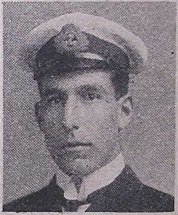
Thomas Milnes Favell
Thomas was born in 1849 at Chester le Street, County Durham, to John and Elizabeth Favell.
His father John was a Yorkshireman, born in Faceby, descended from an old Yorkshire family that can be traced back a further nine generations to the 1580s. He had worked for the East India Company in his early life and now had a pension and owned some land in the local area. John was the Coroner for the Chester ward of County Durham and was often at loggerheads with local council magistrates about the fees he was entitled to, and the basis upon which he called inquests. The magistrates were intent on cutting costs and it seems John was popular for his stand in wanting to get to the truth behind sudden unexpected deaths, particularly in industry and mining which were fraught with danger.
Young Thomas was born into a comfortably well-off middle class family able to afford domestic servants and public boarding schooling. He was an only son amongst five sisters, and likely to have been doted on.
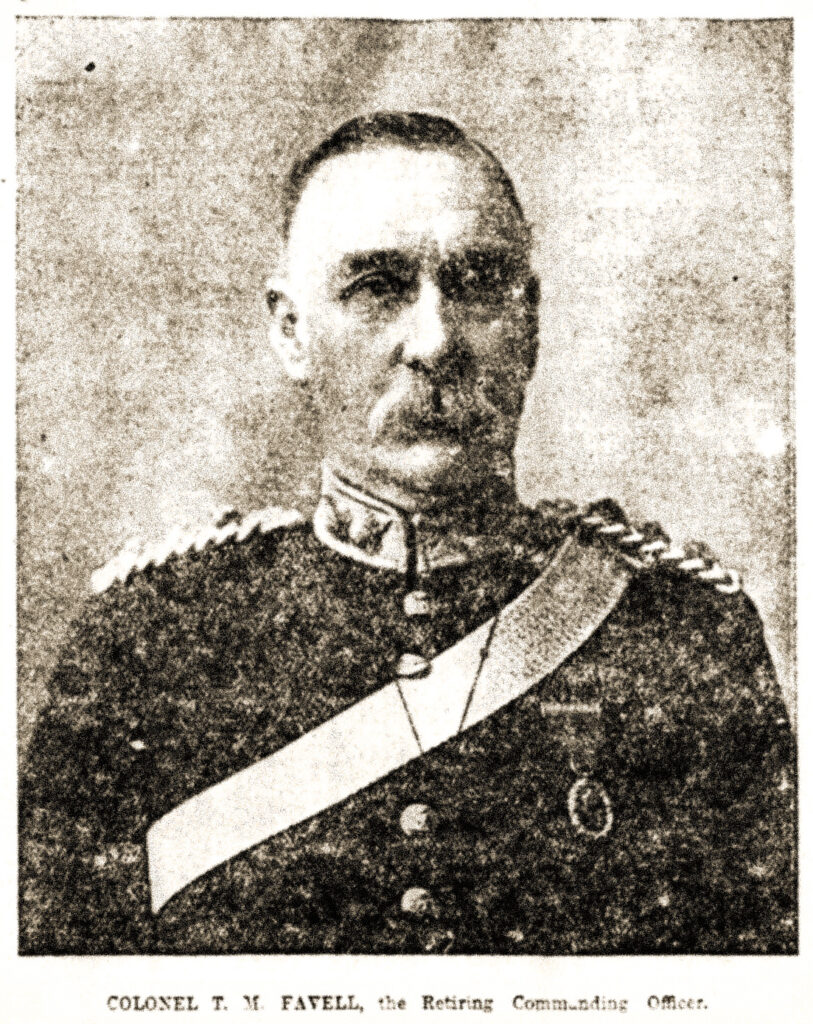
Thomas studied Civil Engineering and at the age of 22 the 1871 census records him as a visitor at the Bainbridge household at Bridge Street, Rothbury. The home of his future wife Anna Bainbridge, two years his senior. Thomas and Anna married in 1872 at St Paul’s church in Upper Norwood, South London with Thomas’s address given as Eighton Cottage, Durham.
Thomas was a part-time soldier. In addition to his Engineering work, Thomas had joined the 1st Volunteer Battalion of the Lancaster Regiment. He was enlisted as a Private at the age of sixteen, rising to the rank of Sergeant.
In 1880 he was commissioned as a 2nd Lieutenant in the Tynemouth Volunteer Artillery, but as his business interests required him to move to Staffordshire, he transferred to the 1st Shropshire & Staffordshire Volunteers. He quickly became a Captain, and after completing 22 years of service, a Major.
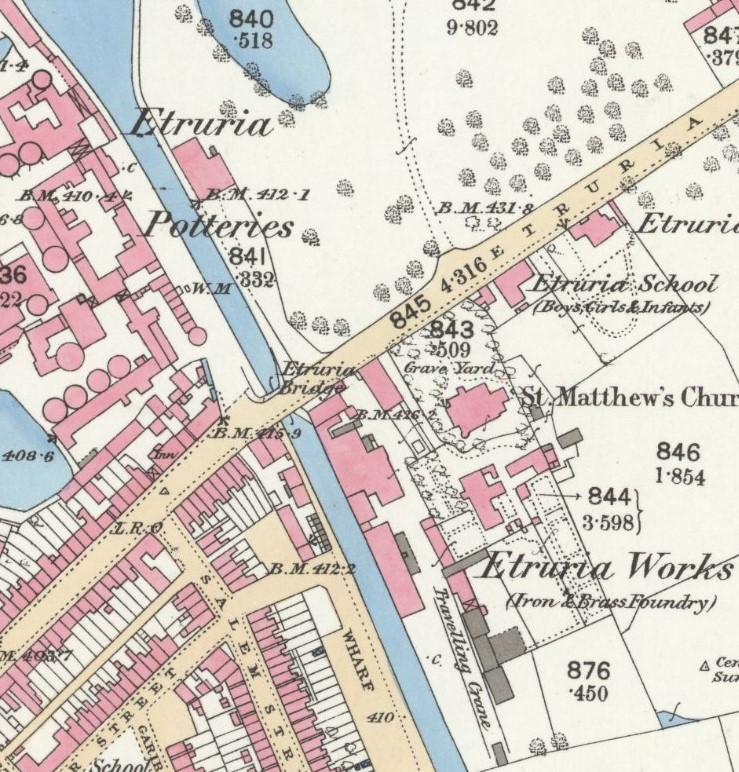
His move to Staffordshire was due to becoming a partner in the Etruria Iron Works in Stafford. An iron and brass foundry in the midst of the potteries, in Stoke-on-Trent. On the bank of the Trent & Mersey canal, it traded under the name of George Kirk & Co, the original founder.
In 1882 Thomas’s 76 year old father John died after being thrown from his horse. Being an only son, it is likely at this point that Thomas inherited the bulk of his father’s property in Durham.
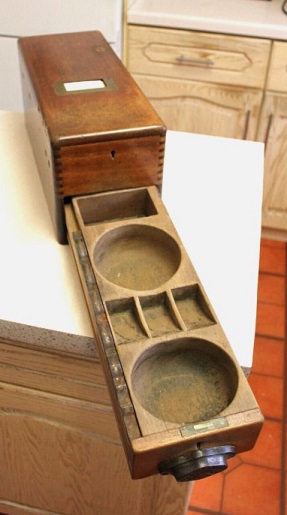
As well as the iron works, Thomas was involved in another business in the form of a partnership in the ‘Stokes Patent Check Till Company.’ A manufacturing concern trading from number 67 Piccadilly, in Hanley. Patented by Stokes, another partner in the business, the company made wooden shop tills, that registered transactions and aimed to prevent any fraud by shop assistants. The business lasted until 1889 before the partnership was dissolved to be continued by Stokes alone.
From the same address of number 67 Picadilly in Hanley, Thomas was the Chairman of ‘The Prizeries Limited’. This seems to have been a company that regularly offered competition prizes in numerous newspapers up and down the country, where entrants were set seemingly odd tasks such as counting the number of particular letters of the alphabet in Testaments of the Bible. People would write in with their answers, accompanied by unused postage stamps by way of payment. Correct entries would be guaranteed either cash prizes or watches and the like. This sounds like the forerunner of today’s phone in prize competitions and not the sort of operation that Thomas would normally be involved in. The business was voluntarily wound up in April 1892 and I suspect Thomas was in an ‘investor’ type role.
So far as family life, in 1891 Thomas and Anna were living at Seabridge, Stoke on Trent. Thomas was by now 42 and gave his occupation as Civil & Mechanical Engineer. The couple had six children, two girls and four boys.
The oldest was Maud who was 15 and still at school, followed by John Milnes, Francis Baker, Eveline, Ernest Torre and Norman Bainbridge, the youngest aged 4.
Also in the household were a Governess (for the children), a Cook, Domestic Servant, Laundrymaid and Nurse. Thomas’s business dealings were obviously enough to keep them all in a comfortable lifestyle and later, the children in private and public schools.
In 1901 Thomas was appointed as a Director of the Staffordshire Potteries Waterworks Company and alongside his ‘day job’ his continued service in the Volunteers had earned him the Volunteer Decoration for his long service.
He finally retired from the Volunteers, by then the Territorial Army, on his 60th birthday in 1909 having reached the rank of Colonel and the commanding officer of the 2nd North Midland Brigade.
In the late 1890s, Thomas and his family had moved to the South of the country and were now living in ‘Fairwood’ a large house in Weybridge, Surrey. At the age of 60 Thomas made no application to extend his service in the Territorial Army due to the amount of travelling required to attend the Brigade HQ in Staffordshire. He was already Chairman of the North London Rifle Club and regularly participated in National Rifle Association competitions at Bisley.
Not wishing to become inactive, Thomas became a County Councillor representing Weybridge on the Surrey County Council. Some of the issues that he was involved with related to the Brooklands race track that was newly being carved out of the countryside around Weybridge at that time.
Thomas and Anna’s children gradually left home to attend boarding school, university or followed their father’s footsteps in joining the armed forces at an early age. With the Great War looming and due to their ages and occupations, it was inevitable that Thomas’s sons would serve in it. By 1915, at the age of 66, Thomas himself was back out of retirement and helping the war effort, having volunteered for enlistment. The novelty of someone of his age joining up made the newspapers. He served for 18 months in a training battalion as a Second Lieutenant in the Royal Engineers before returning to the Council. The family did not end the war unscathed, losing a son in the conflict, and this is probably what spurred him on. He was quoted as saying “If the younger ones won’t join, then the older men must.”
Thomas died in 1936 at the age of 86 years. His wife Anna died just a year later at the age of 91.
But what of the children of John and Anna? Their relatively comfortable position and to an extent ‘head start’ in life paints an interesting picture of the times in what was then still the British Empire. The sons followed their father in Engineering or the armed forces, while the daughters followed religion and music. Presumably
They all were supported with some form of private income as their chosen careers would have immediately supported the lifestyle they were accustomed to.