Samuel Favell
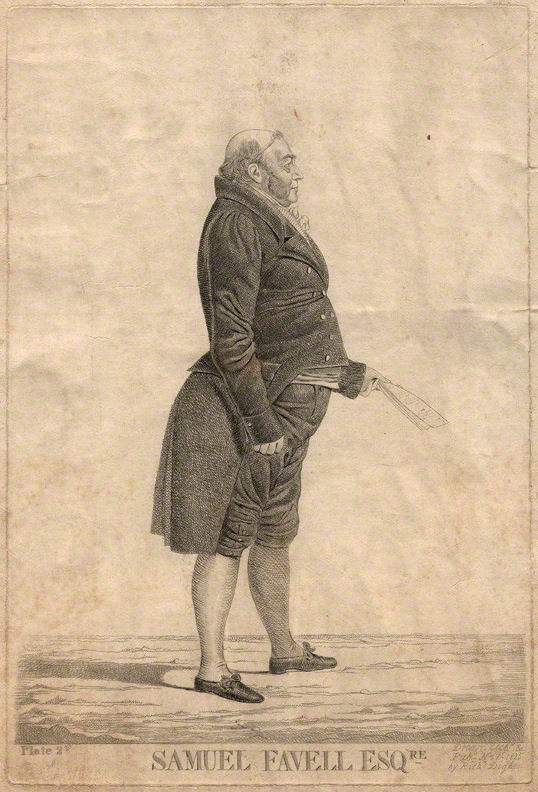
Samuel Favell was a businessman who started his career as an apprentice to his father, a Freeman of the Cloth Workers Company of the City of London. Through successful business partnerships, his association with the Cloth Workers Company, and investments, the one-time apprentice acquired wealth, got involved in politics and philanthropy. Some of the decisions he made are interesting and give some insight to his character.
When Samuel Favell died at the age of 70 in 1830, he was a rich man, and able to leave a trust worth £2,000 (£199,000 at today’s values) for his wife Elizabeth to receive a comfortable income. Elizabeth also received his leasehold house in Camberwell along with all of its’ fixtures, fittings, furniture, linen, books, pictures, wine and other chattels and effects. Also, all his ‘plate’, except for special items for his sons and daughter. His gold watch chain and seals he left to his son John, a gold snuff box presented by the Corporation of Londonderry to his son Richard, and a silver urn and silver tea pot presented by the Irish Society to his daughter Caroline.
His son John also received Samuel’s share in the London Institution, Moorfields, and ten shares in the Union Fire Office, as did Richard. There were also Freeholds in Fenchurch Street, Walworth, Southwark, Peckham Rye and Covent Garden in trust to his son John and nephew Richard Boswell Beddome, with the proceeds of all rents, after expenses, going to his wife during her natural lifetime, and then to be divided between the sons and nephew.
For his daughter Caroline there was a sum of £5,000 in trust to purchase securities that would produce a 6 monthly income. There were also sums of £400 to be paid immediately to Elizabeth to cover the periods before rents would come to her, plus £1,000 to each son, plus all the capital money and stock in trade of Favell Beddome and Company of Fenchurch Street, with further instructions regarding for settling debts and collecting credits.
At his own request Samuel was buried in Bunhill Fields graveyard in the City of London, marked by a low granite cope stone that curiously claims that he was of Flemish descent. Perhaps this was from a female line?
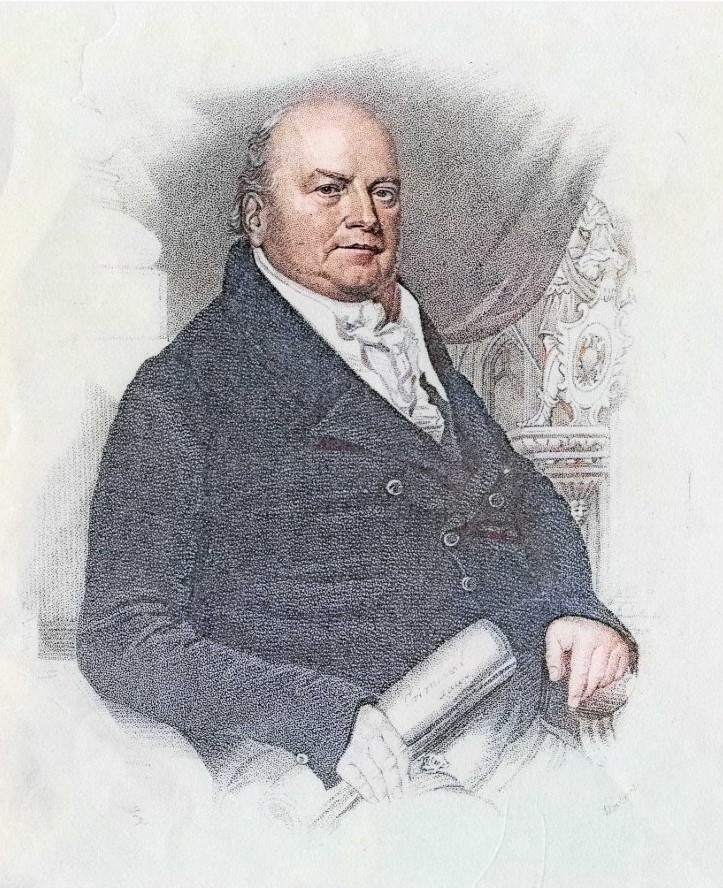
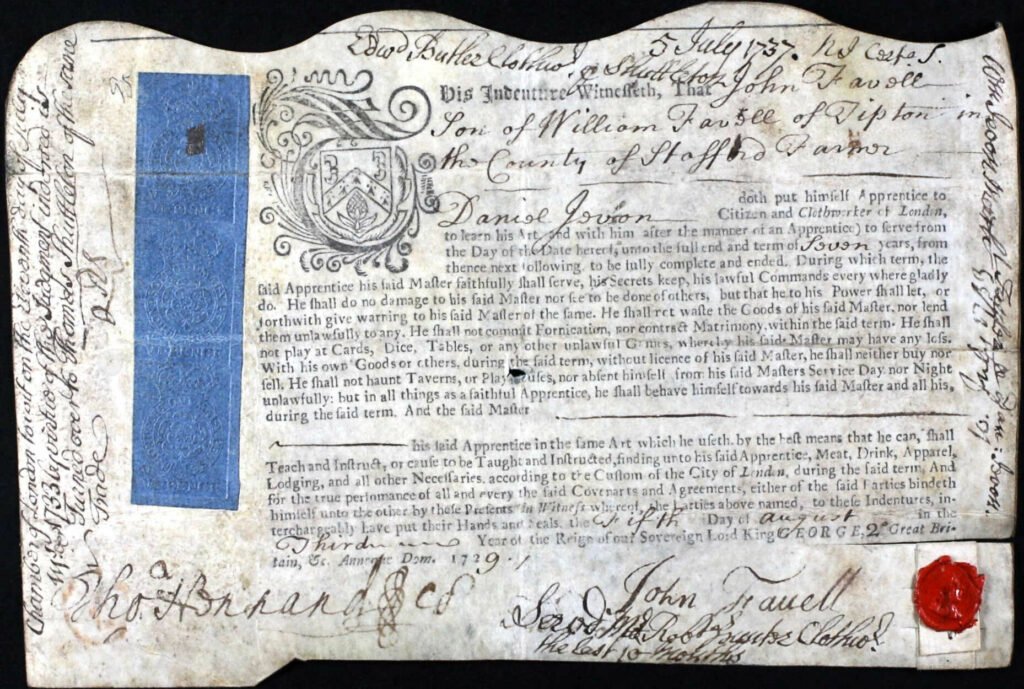
Born in 1760, as a young man Samuel was an apprentice to his father, John Favell, a ‘Slop Seller’ of Tooley Street. Slops was the general term used for lower quality ready-made clothing that also included uniforms for the Navy.
His father John had himself served a 7-year apprenticeship as a Cloth Worker, becoming a Freeman of The Clothworkers’ Company in 1737. He had been apprenticed to a Daniel Jevon, a packer living in Tower Street, London. John was described on his indentures as the son of William Favell of Tipton in Staffordshire. His occupation at the time he became a Freeman of the Company was ‘Journey man to Mr Hunter’. John eventually went on to become Master of the Cloth workers Company, serving for 1774, the year before he took on his son Samuel as an apprentice.
It would have been a good start for Samuel to be the son of the Company Master and having served his father as an apprentice for seven years, Samuel was made ‘free’ in 1781. The Livery Companies that controlled trade in the City of London dated back to the 1200s and had become trade controlling associations with broader aims than just passing on manual skills. I can imagine the young Samuel learning about the trade, how and where to buy, how to warehouse, transport, selling wholesale and retail etc, rather than learning how to make garments himself. There were now overlaps between the City Companies and for some trades possibly a choice as to whether to come under the Merchant Taylors or Drapers rather than Cloth Workers. Occupations of the Company ‘freemen’ were also varied with some members of the Cloth workers being Tobacconist, Wharfinger or Stockbroker.
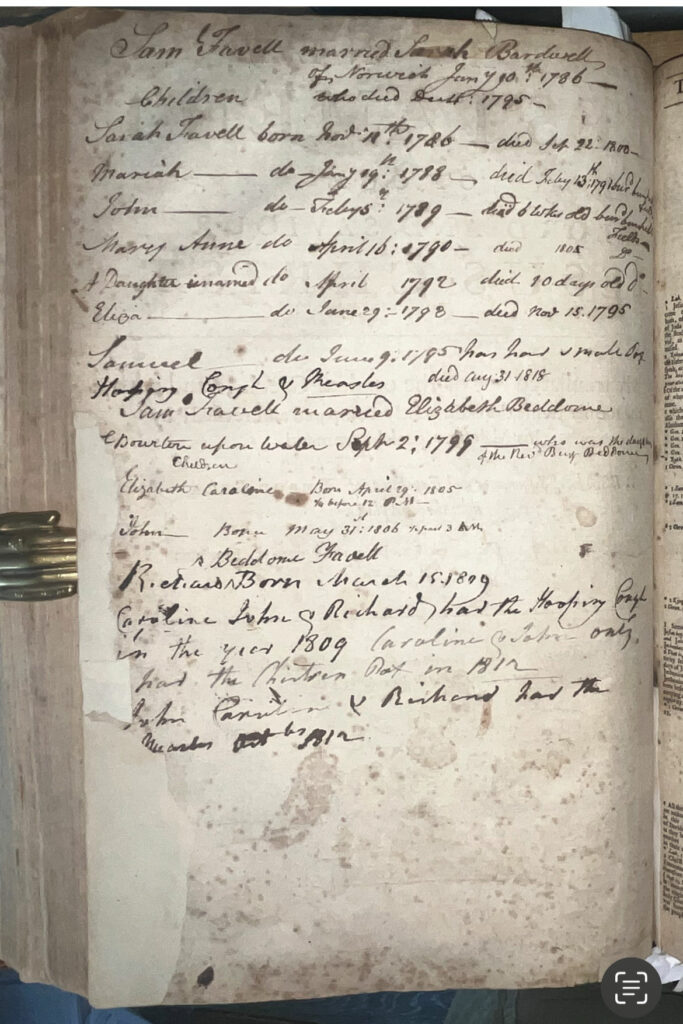
Samuel married Sarah Bardwell in 1786 and they went on to have seven children. Most died in infancy or their teenage years with only the youngest, Samuel junior, survived into adulthood. Within six months of Samuel junior’s birth, Sarah also died.
In 1799 Samuel married again, this time to Elizabeth Beddome. They were married at Bourton on the Water where Elizabeth’s father was a Baptist minister. Beddome Fish & Co. were Woolen Drapers in Fenchurch Street, so it is probable that Samuel and Elizabeth met through trade association. They went on to have three children, John, Richard and Caroline, all eventually beneficiaries in his will.
Samuel junior, the son from his first marriage, followed in the family tradition, being apprenticed to his father, Samuel senior, becoming free in 1816. However, Samuel died just two years later aged just 23, explaining why he is not mentioned in his father’s will.
Samuels’s son John followed the same path in being apprenticed to his father, by now described as a Woolen Draper of Fenchurch Street, becoming free in 1827 and presumably going into business with Samuel.
There were three methods to become a Freeman of a company. The first being Servitude, being bonded to a Master to serve an apprenticeship, usually seven years. The second method was Patrimony, where it was of birthright for the sons and daughters to become Freeman if their Father was already a Freeman of the Company when they were born. The third method was by Purchase. It is interesting to me that even though both of Samuels sons would have been eligible to qualify by Patrimony, they both attained their Freeman status by Servitude. Was this Samuel’s choice to ensure they learned their trade properly before being let loose in the family business?
Samuel was very well aware of the Patrimony route and was a signed witness on behalf of the Company granting new Freeman status to several who were practicing other trades. I wonder if he frowned upon the practice.
As well as his trade associations with the Cloth Workers Company, Samuel was interested in Radical Politics and held sympathies with the struggles of the French Revolution and the possibilities of a Republic as opposed to a Monarchy. These views were not popular within the City Guilds and Samuel was at one point lampooned in the Times Newspaper with satirical pieces supposedly penned by ‘Sammy Slop’ about the ‘Southwark Slop Seller’ or ‘Modern Reformer.’
Later, these frictions seem to have been overcome and from 1809 to 1829 Samuel was a member of the Common Council of the City of London, the City Corporation that governed the City of London. Not forgetting he was the Master of the Clothworkers company in 1813 and would have been involved in the City Guildhalls. His Slops business obviously enabled him to invest in freehold properties and benefit from the rents accrued, acquiring him a tidy sum over the years.
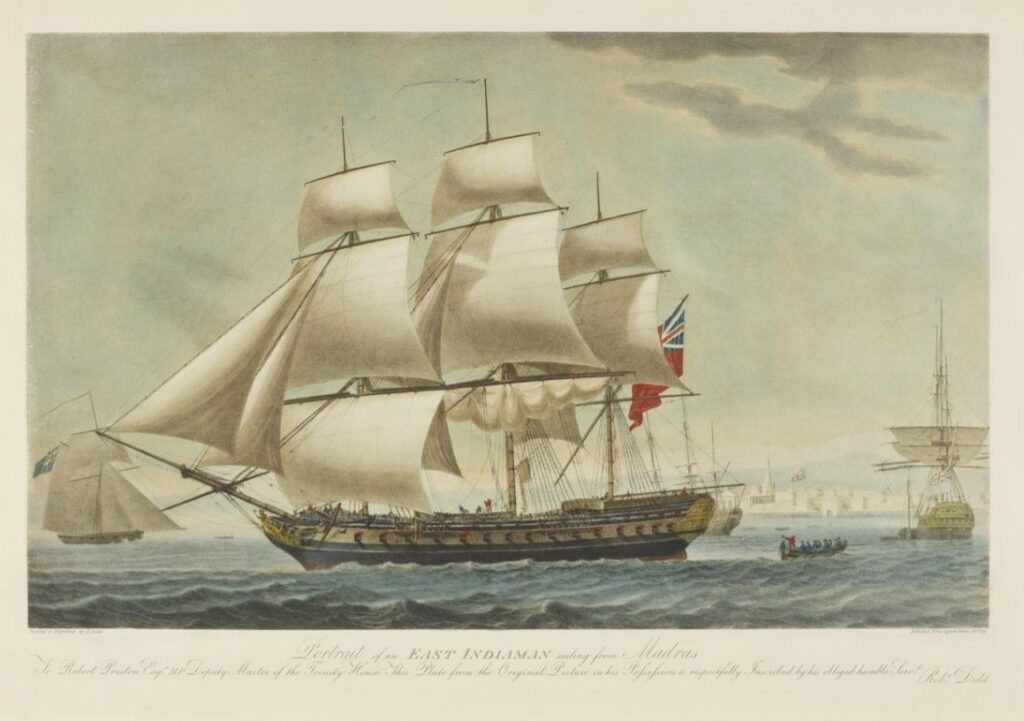
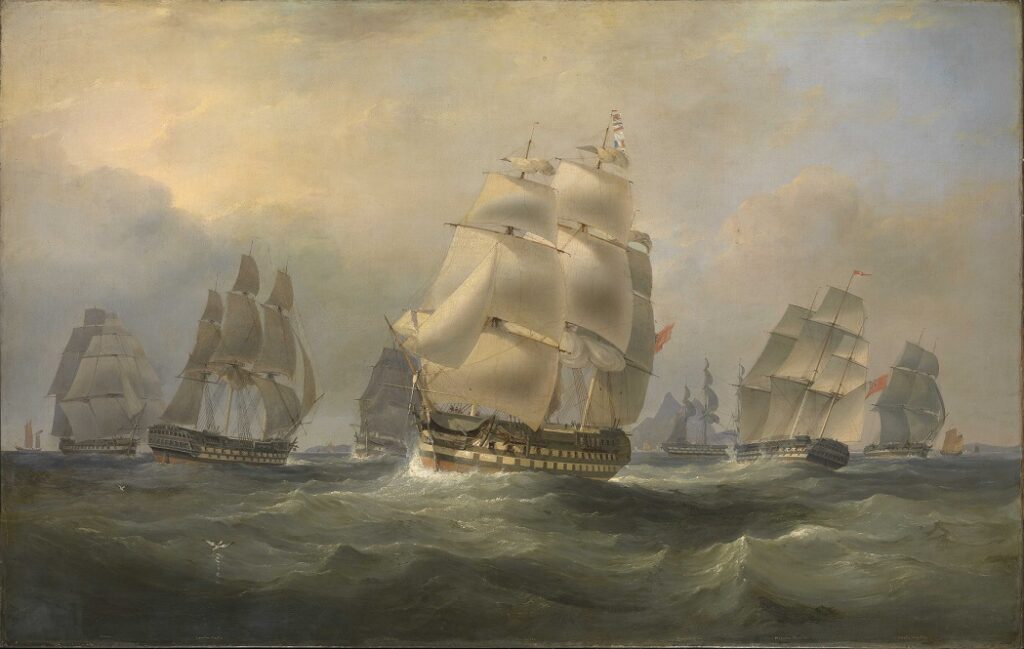
But it would seem not all of his wealth was generated from the ‘slops’ business. Possibly through his business acquaintances, his contacts in the trade guilds or his politics and coffee shop meeting houses, Samuel invested to become a ship owner. In 1801 the ‘Devaynes’ was launched, probably built at Deptford further down the river Thames from Tooley Street. Samuel was the registered owner and the ship was tendered to the East India Company for a duration of six voyages. I doubt that Samuel had any involvement in the building or operational aspects of the ship but was likely to be an investor from the point of view of putting up the money.
Ships did not last long and each sea journey, possibly of several years duration, took its toll on the structure. The East India company had given up building its own ships as the expense of constant replacement was crippling. Instead, they oversaw ships being built to their specification, funded by private investors, the hired or leased for a set number of journeys. Space on the vessels was rented out by the Company to the traders who purchased and moved the cargos to and from the East Indies. Unlike the West Indies, the East India trade was commercial and not connected with the West Indies plantations and slave trade.
The Devaynes (named after William Devaynes, an East India Company Director) was a third class ship of 600 tons, armed with 18 twelve pounder guns. Although not a Royal Navy ship, the crew would have been defensively armed to provide self-protection from piracy and attack from Britain’s enemies. At this time Britain was at war with France and their ally Spain. Nelson’s famous battle at Trafalgar was only a few years away when Devaynes set off on her first voyage. The East India Company raised it’s own army to defend the Companies interests and at one time had a force three times larger than Britain itself.
The Devaynes was rated at £13 a ton, so could have earned Samuel £7,800 for each of the voyages it made under his ownership (if only charged one-way) before he sold it on. At times Devayne was licenced by the Government as a Privateer, and being armed could capture and take as prizes, any ships deemed to belong to enemies of the United Kingdom.
The Devaynes sailed three voyages under Samuel’s ownership. The first voyage, bound for Calcutta set off in August 1802, returning to Gravesend in April 1804. The second departed Portsmouth in September 1804 reaching Madras in June 1805. Shortly in her return journey she became leaky and had to leave a convoy of other Indiamen and sail to Penang for a refit. She eventually arrived home in June 1806.
Her last voyage under Samuel’s ownership left Portsmouth in January 1807 bound for Madras and Bengal. On her return she reached the Cape on 31st December 1807 and arrived in the English Channel in April 1808. Potentially generating revenue of £46,800, or around £4M at today’s values. Perhaps this is where the majority of Samuel’s initial wealth came from? Perhaps there is more to uncover?
Samuel sold the Devaynes before she set off on her next voyage. She went on to complete another three before being condemned after springing leaks on a return trip from Bombay when she had to put back into harbour. She was broken up in 1817, after 16 years and six journeys.
In 1813, following in the footsteps of his father, Samuel became the Master of the Cloth Workers Company. Since completing his own apprenticeship to his father, Samuel was the Master of nine apprentices that were each bonded to him for seven years. These included two of his sons, Samuel (the younger) and John, one the sons from his second marriage. There were also two sons of his Business partner William Bousefield. Samuel took on apprentices from shortly after gaining his own ‘Freedom’ right up until his death in 1830, when his last apprentice William David, was transferred to his son John Favell as Master to complete his time. At one point Samuel had four apprentices bonded to him.
Samuel was a philanthropist as well as a businessman, and was one of the Founders of Mill Hill School, involved in the foundation of the Guildhall Library, the University of London, and the Sunday School Society.
He was a Deacon of the Camberwell Congregational Church and ‘worked untiringly for Catholic Emancipation and Parliamentary Reform, and for the abolition of the Slave Trade, and slavery, and the atrocious cruelties of the Criminal Law’ according to the history of Mill Hill School 1807 – 1923.
It seems that Samuel’s son John died in 1859, leaving no heirs and making no mention of his brother or sister in his will. Samuel’s fortune being amongst cousins and friends.
In late 2025 an antique bible, containing family tree information relating to Samuel, his marriages and children, appeared for sale on the auction web site Ebay. It may be coincidental, but around the same time several Favell family wills relating to the Yorkshire family, dating back to the 1600s also came onto the market via an entirely different seller. I wonder if they originated from the same source with family records being disposed of and possibly there is some link between the London and Yorkshire family.
As well as from other sources, much additional information has been gleaned from this web site.
Samuel had a brother, by the name of John. His life could not have been more different. Having travelled to Canada he worked for the Hudson Bay company and took a local wife, a native of the Cree nation. Their children are likely to be the ancestors of the Canadian Cree / Metis Favells